Driveline noise usually comes from one of four places. A clicking or popping on tight turns points to a worn outer CV joint. A clunk when you shift into gear or get on and off the throttle often means a worn U-joint or loose driveshaft part. A whine that changes when you accelerate or coast points to the differential. A hum or growl that rises with road speed is often a wheel bearing, which people mistake for a driveline fault all the time.
You can find the rest of the Blue Rose Auto Engine & Transmission Guide from its overview page.
What the driveline is
Everything between the transmission and the wheels counts. On a front-wheel-drive car, that is two short axles with constant velocity (CV) joints at each end. Rear-wheel-drive trucks use a driveshaft with universal joints (U-joints), a rear differential and two axles. All-wheel and four-wheel drive vehicles add a transfer case, a second driveshaft and a second differential.
Each of those joints and gear sets has a typical sound when it wears. Matching sound to situation is most of the diagnosis.
Sound, situation and likely cause
| What you hear or feel | When it happens | Likely cause | Urgency |
|---|---|---|---|
| Rapid clicking or popping | tight, slow turns, like parking | worn outer CV joint | book soon |
| Clunk or knock | pulling away, shifting into Drive or Reverse | worn U-joint, inner CV joint, slack in the differential | book soon |
| Squeak that speeds up with the car | low speeds, rear-drive trucks | dry U-joint | book soon |
| Vibration that grows with speed | highway speed, often under load | driveshaft balance, U-joint, center support bearing | book soon |
| Whine on acceleration, quiet when coasting (or the reverse) | steady speeds | differential gear wear or low oil | moderate |
| Hum or growl rising with speed, changes when you sweep left or right | 30 mph and up | wheel bearing | book soon |
| Binding or hopping in tight turns on 4WD | dry pavement, 4WD engaged | 4WD used on high-traction surfaces | switch back to 2WD |
| Grease flung inside the wheel | anytime | torn CV boot | book soon |
Telling the joints apart
CV joints are packed in grease and sealed by a rubber boot. Once the boot tears, water and grit get in and the joint starts to wear. Caught early, a torn boot is a much smaller job than a clicking axle. After a wet Oregon winter, a quick look behind the front wheels with a flashlight is worth the minute it takes.
U-joints are small cross-shaped joints at each end of a driveshaft. When the needle bearings inside dry out, the joint squeaks, then clunks, then can fail. If a rear U-joint fails, it can drop the driveshaft onto the road, which is why a new clunk on a pickup deserves attention.
Differentials let the left and right wheels turn at different speeds through a corner. Low or old gear oil and worn gears produce a whine that changes with throttle. Worn pinion bearings classically howl only on the overrun, as you lift off.
Wheel bearings are not strictly part of the driveline, but they cause most of the hums people blame on it. Try this: on an empty, safe road, gently weave left and right at 40 mph. If the hum gets louder when you load one side, a bearing is the likely suspect.
Is it the driveline or the brakes?
Some noises sit on the border. Grinding or scraping that appears only when you press the brake pedal belongs to the brakes, not the driveline. A noise that is there whether you brake or not, and changes with throttle or turning, points back here. For brake sounds in detail, compare with brake warning signs.
The transmission can also be the source. A whine that rises with engine speed rather than road speed, or a clunk only at the moment of a gear change, may belong to the gearbox. Our transmission warning signs page covers those.
Things to check before you book
- 1Note whether the noise follows engine speed or road speed. Any sound that changes the moment the transmission shifts tracks the engine; one that only grows as the car goes faster tracks the road.
- 2Note turning direction. Clicking on left turns usually points to the right outer CV joint, and vice versa.
- 3Look for grease spatter on the inside of the wheels and under the car.
- 4Check for open recalls by VIN through NHTSA's recall search. Axle and driveshaft recalls do happen.
What affects the repair cost
- Which part. A CV boot, a U-joint and a differential rebuild are very different jobs.
- Repair or replace. Many CV axles are replaced as a complete assembly. Differentials may be rebuilt or swapped.
- Drive layout. AWD and 4WD systems have more parts and sometimes need matched components.
- Spread of damage. A neglected boot ruins the joint. Left dry, a U-joint can damage the yoke it sits in.
- Fluids. Differential and transfer case oil changes are often part of the job.
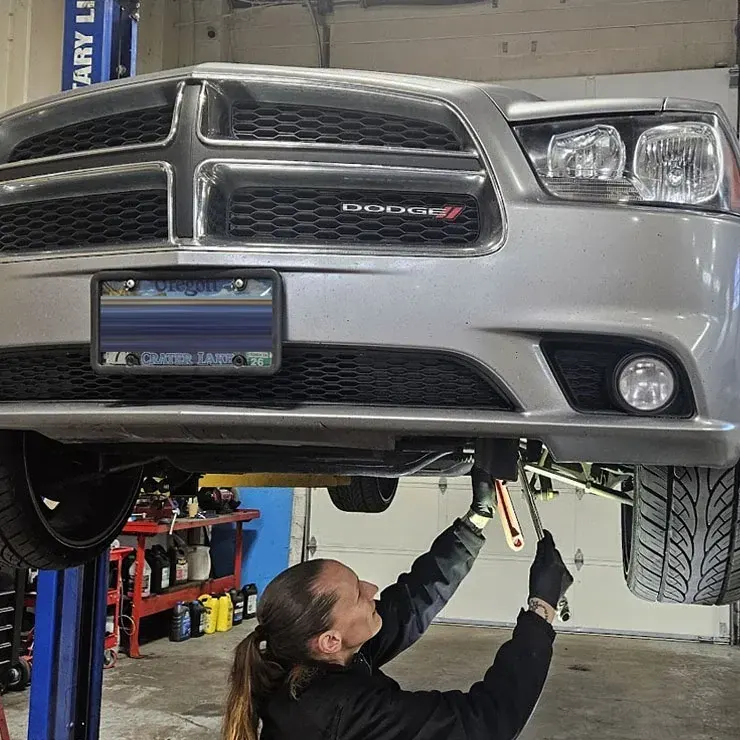
Blue Rose Auto Care & Repair Services, the Springfield, Oregon repair, collision and detailing shop, has ASE-certified technicians for mechanical work like this. Blue Rose Auto started in 1994 as a detail business in Junction City and now covers mechanical repair under the same roof. If your car is clicking, clunking or humming, the shop's drivetrain repair details explain how to arrange an inspection, so bring the notes from the checklist above.